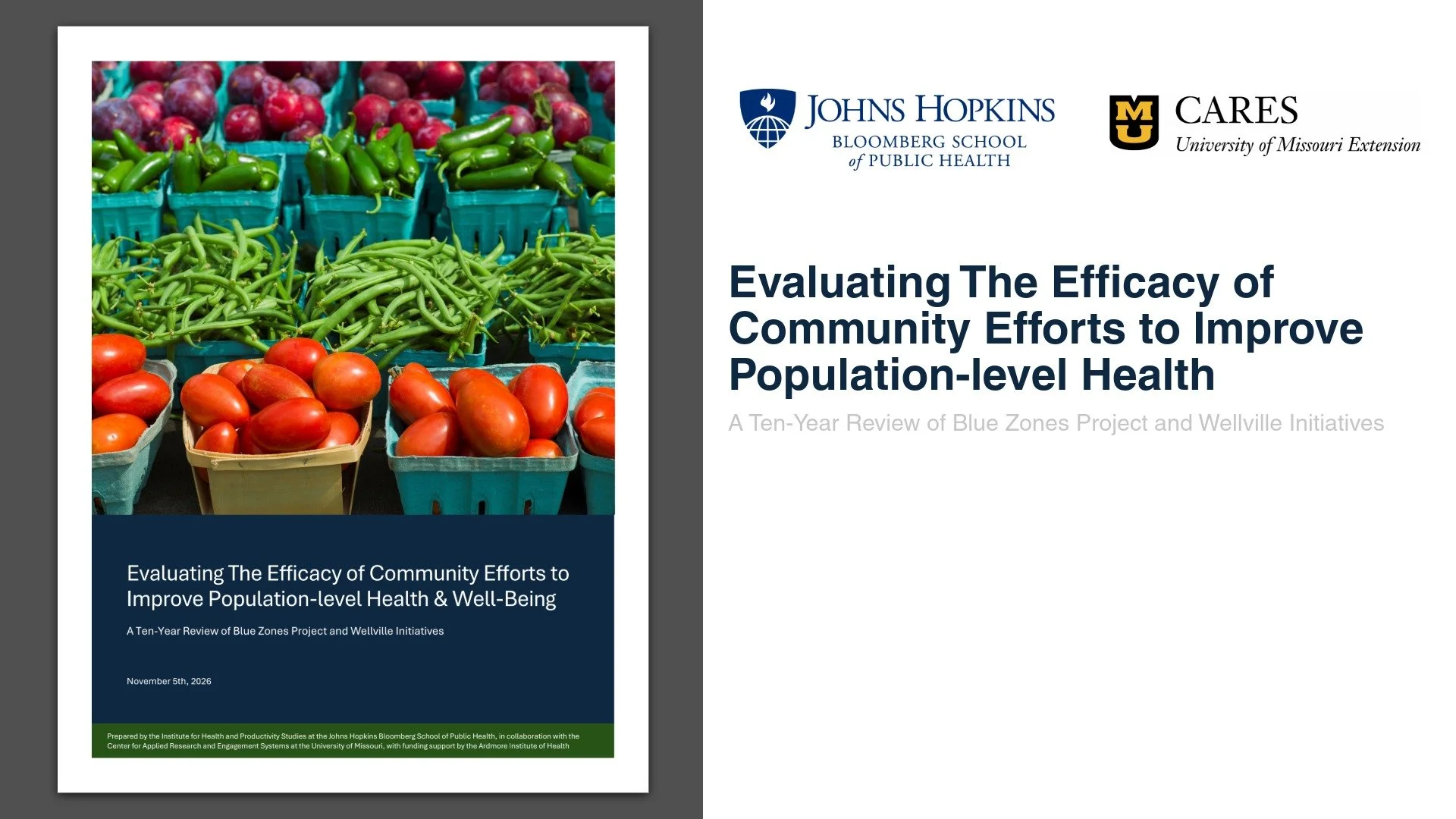
Johns Hopkins University and the University of Missouri Extension Center for Applied Research and Engagement Systems recently evaluated the health impacts of Blue Zones Project and Wellville initiatives, which aim to improve community health and well-being. The purpose of the study was to determine whether these initiatives were effective in improving outcomes across several key individual and community health indicators.
The resulting report is available here.
Executive Summary
Blue Zones Project (BZP) and Wellville (WV) are community transformation initiatives intended to improve population health by leveraging multisector partnerships to develop and/or implement locally adapted strategies to address health behaviors and community environments. Rigorous evaluations of such initiatives are challenging because implementation is nonrandom, multifaceted, and heterogeneous across communities.
We conducted a longitudinal, matched county-level evaluation of 8 BZP and WV intervention counties, including data from 24 carefully matched comparison counties. We examined outcomes related to chronic disease prevalence, behavioral risk factors, and social determinants of health from 2012 through 2023, depending on data availability. The primary analysis used difference-in-differences models comparing changes after 2017 in intervention counties with changes in matched comparison counties. Secondary analyses included program-stratified analyses comparing BZP with WV.
We found that intervention counties had greater improvements than comparison counties across most of the primary outcomes over our analytic period. This included favorable changes in poor mental health days, tobacco use, physical inactivity, adult obesity, poor or fair general health, and low social associations. However, in the pooled analysis, only one outcome (poor mental health days) was statistically significant. The confidence intervals for all other outcomes included the null.
Additionally, program-stratified analyses provided little evidence that either BZP or WV was consistently associated with more favorable changes than the other program, although there were differences on specific outcomes. Notably, tobacco use showed a more favorable change in BZP counties than in WV counties.
Overall, this evaluation did not detect broad, statistically robust, county-level health improvements associated with BZP or WV during the study period. However, these findings should not be interpreted as evidence that the initiatives had no effect: effects may be localized, delayed, concentrated in specific populations, or inadequately captured by available county-level measures. Directionally favorable findings, particularly for tobacco use and mental health, warrant further study. Future evaluations should incorporate longer follow-up and direct measures of implementation intensity, reach, participation, policy and environmental changes, and neighborhood- or population-specific outcomes.
Ardmore Institute of Health provided grant funding for this initiative.
Continue Exploring: